Your Lack of Planning Is Not My Emergency
Yes, we all know construction has a reputation for chaos.
Schedules slip. Budgets shift. Problems appear unexpectedly and demand immediate solutions. Over time, many people begin to accept this as simply the nature of the work.
But much of what gets labeled as “construction chaos” is not chaos at all.
More often, it is the predictable result of decisions that were never fully worked through before the work began.
I used to say something fairly blunt when I was a project manager:
“Your lack of planning is not my emergency.”
It usually came up when someone insisted we should just keep a project moving — even if key decisions hadn’t been made yet.
The truth is, construction moves quickly. It always will
A renovation site is a constant sequence of decisions. Questions come up daily, sometimes hourly. Conditions change. Details need to be resolved. Trades need answers in order to keep their work moving forward.
Construction moves quickly — but good construction is not about speed. It’s about making sure that when decisions are made, they are informed.
But speed and thoughtfulness are not opposites.
Good construction is not about slowing everything down unnecessarily.
It’s about making sure that when decisions are made quickly, they are informed.
Every decision in a renovation carries consequences — cost, sequencing, material availability, structural realities.
In many ways, construction becomes a series of rapid cost-versus-risk assessments.
Experience helps with that.
Over time you begin to recognize patterns: how older homes were built, how materials interact, where hidden conditions are most likely to appear. Decisions stop being guesses and start becoming informed judgments.
But there is another part of the job that is rarely discussed.
A builder’s role is not only to manage the complexity of construction — it is also to shield the client from it.
I was reminded of this recently during a conversation about Korv, a traditional Swedish sausage I grew up eating at Christmas.
For years it was simply one of my favorite holiday traditions.
Then one year my mother and grandmother decided it was time for me to participate in the making of the Korv.
Watching the process — the grinding, the casing, the smells — changed something for me. Suddenly I could see the mechanics behind something that had once felt simple and comforting.
And after that, it was hard to eat Korv the same way again.
Construction has its own version of sausage making behind the scenes.
Behind every finished space is an enormous amount of coordination, judgment, problem-solving, and decision-making that most clients never see.
And they shouldn’t have to.
The goal of a well-run project is not to expose every messy detail of how the work happens. It is to manage those complexities so the client can experience the outcome without having to carry the weight of every decision behind it.
Thoughtful planning plays a huge role in that.
When key decisions are made early, when materials are coordinated, and when the building itself has been carefully studied, the work begins to move with surprising calm.
Unexpected discoveries still happen — renovation will always involve some degree of discovery.
But instead of constant emergencies, they become manageable adjustments within a project that already has direction.
And when that happens, construction becomes what it was always meant to be:
The careful execution of decisions that have already been thoughtfully made.
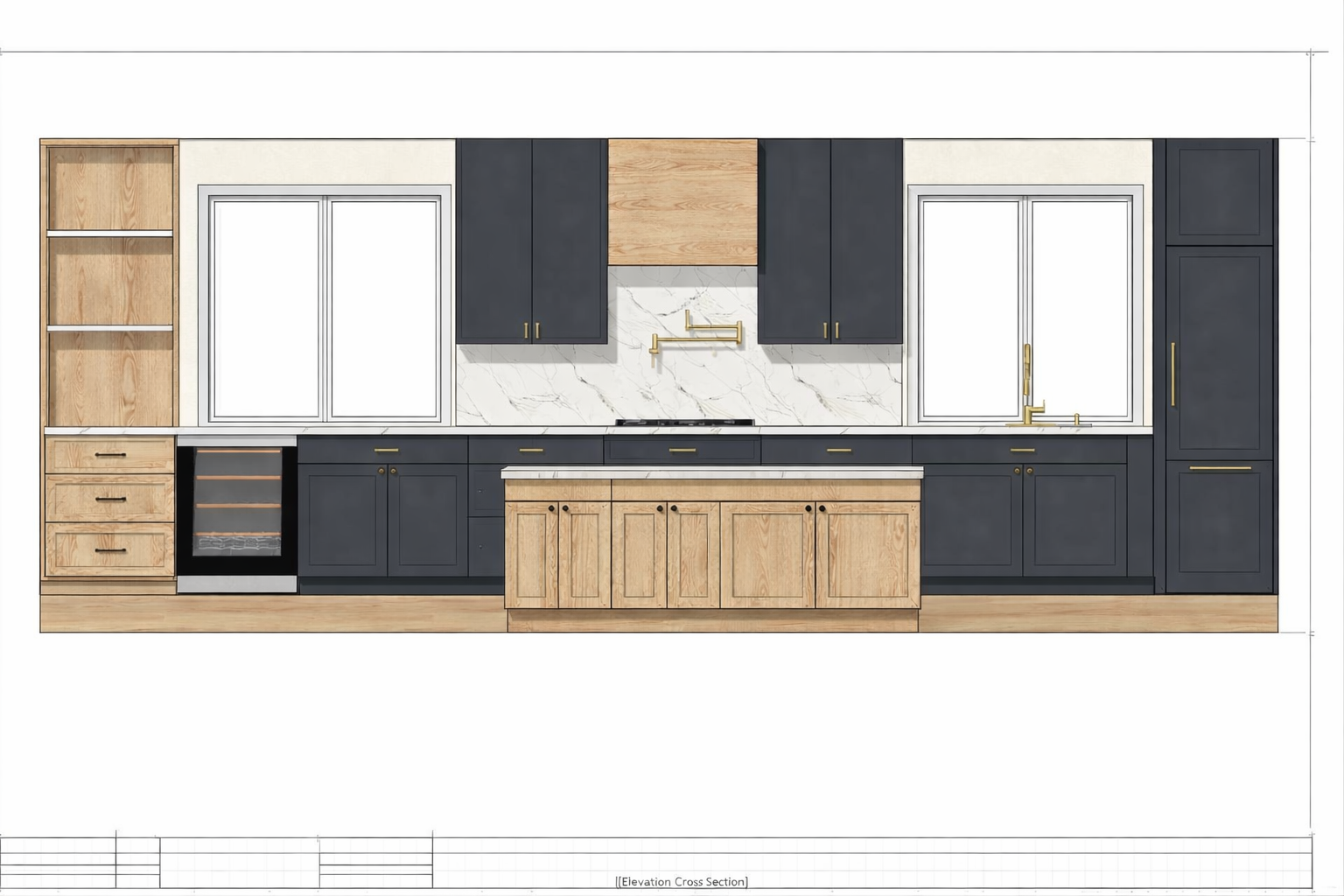
Planning turns ideas into something that can actually be built.